
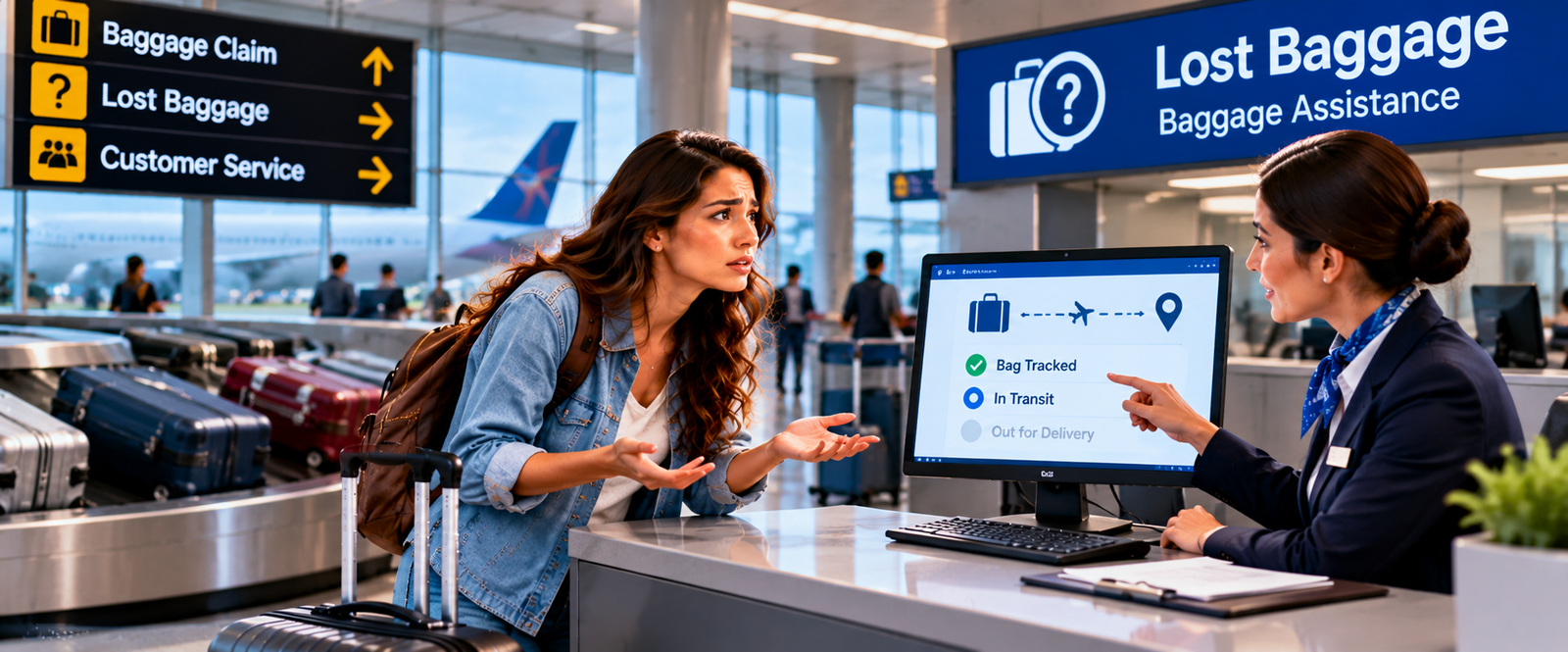
Arriving at your destination without your luggage can be frustrating, especially after a long flight or an important journey. Whether your suitcase is delayed, misplaced, or officially declared lost, understanding the lost baggage claim process can help you take the right steps.
Airlines handle thousands of checked bags every day, and baggage disruptions can occur because of missed connections, handling errors, incorrect routing, or operational delays.
At Flightshelpr, we provide helpful information about lost baggage reporting, missing luggage tracking, airline baggage policies, compensation rules, and reimbursement procedures.
If your checked bag has not arrived, acting promptly and keeping accurate records can make the recovery and claims process easier.
Learn How to Report Lost Baggage, Track Your Luggage, and Understand Your Passenger Rights.
Lost baggage refers to checked luggage that an airline cannot locate or return to its owner after travel.
However, a bag that does not arrive on the same flight as its owner is not necessarily permanently lost.
Airlines generally distinguish between delayed, lost, and damaged baggage.
Delayed baggage refers to checked luggage that does not arrive as scheduled but may still be located and delivered later.
Lost baggage refers to luggage that the airline determines cannot be recovered.
For flights covered by applicable US rules, a checked bag may also be treated as lost when it remains missing beyond the airline’s stated or applicable time threshold.
Damaged baggage refers to luggage or eligible contents that are damaged during airline handling.
Each category may involve different reporting and reimbursement procedures.
If your checked luggage does not appear at baggage claim, take action before leaving the airport whenever possible.
Confirm that you are waiting at the correct baggage claim carousel.
Review airport information screens and airline notifications.
Report the missing bag to the operating airline’s baggage service office.
For connecting flights involving multiple carriers, the appropriate reporting airline may depend on the itinerary and baggage handling arrangement.
Your baggage claim receipt contains a tracking number that can help the airline identify your luggage.
Complete the airline’s baggage irregularity report or equivalent missing baggage form.
Provide accurate contact details and a description of your luggage.
Save the baggage report reference number for future tracking and communication.
If the airline locates your bag, ask whether delivery to your hotel or home address is available.
Save receipts for reasonable essential purchases made because of the baggage delay.
Reimbursement eligibility depends on the circumstances and applicable rules.
Many airlines provide online baggage tracking services.
Depending on the airline, travelers may be able to check baggage status through its website, mobile application, or baggage tracing system.
Baggage report reference number
Baggage tag number
Passenger last name
Flight number
Travel date
Contact information
Searching: The airline is attempting to locate the missing bag.
Located: The airline has identified the luggage.
In Transit: The bag is being transported toward the appropriate destination.
Ready for Delivery: The bag may be available for collection or delivery arrangements.
Tracking terminology varies by airline.
If tracking information is unavailable or does not change, contact the airline’s baggage service department.
Baggage disruptions can happen for several reasons.
A checked bag may fail to transfer between flights when connection times are short.
Handling errors may cause luggage to travel to the wrong airport.
Unexpected schedule changes can disrupt baggage handling and transfer arrangements.
Damaged or unreadable baggage tags can make identification more difficult.
Operational problems involving baggage systems may delay luggage processing.
Another traveler may accidentally collect a bag that looks similar to their own.
Adding a distinctive luggage tag can help reduce confusion.
If your luggage remains missing, the airline may require a formal claim.
Create an initial baggage report as soon as possible.
Check the airline’s official lost baggage claim process and submission deadlines.
You may need:
Flight ticket or itinerary
Boarding pass
Baggage claim receipt
Missing baggage report number
Description of the suitcase
Itemized list of missing belongings
Receipts or other proof of value
Complete the airline’s required claim form and provide supporting information.
Keep copies of your submission and correspondence.
If compensation is offered, review the calculation and any applicable liability limitations.
For domestic US flights, airline liability for lost, delayed, or damaged checked baggage is governed by applicable federal rules.
The US Department of Transportation establishes a maximum liability limit for covered domestic baggage claims, which is adjusted periodically.
This limit is not an automatic payout.
Passengers generally must establish eligible losses, and reimbursement may be subject to exclusions, depreciation, and other lawful conditions.
Airlines may also offer additional protection or declared-value arrangements under certain circumstances.
Travelers should verify the current domestic baggage liability limit and applicable airline policies before submitting a claim.
International baggage claims may be governed by the Montreal Convention or other applicable legal frameworks.
Under the Montreal Convention, baggage liability is generally subject to a limit expressed in Special Drawing Rights (SDRs), an international monetary unit.
The applicable limit can change through periodic adjustments.
The amount payable in a particular case depends on the applicable convention, supporting evidence, and eligible losses.
For many covered international journeys, the current Montreal Convention baggage liability limit is 1,519 SDR per passenger, effective December 28, 2024.
This amount is a liability ceiling, not a guaranteed compensation amount.
Travelers should verify the rules applicable to their itinerary and file claims within the required deadlines.
If your checked luggage is delayed, you may need to purchase essential items while waiting for its return.
Depending on the circumstances, reasonable expenses may include:
Basic toiletries
Essential clothing
Necessary personal items
Other reasonable purchases directly related to the delay
For covered US airline travel, carriers generally cannot impose arbitrary daily reimbursement caps that prevent payment of reasonable, verifiable expenses within applicable liability limits.
However, expenses must still be reasonable and supported by appropriate documentation.
Keep itemized receipts and submit them according to the airline’s instructions.
If the airline locates your missing luggage, it may arrange transportation to your destination airport or another agreed location.
Delivery arrangements vary by airline and circumstances.
Before accepting the bag, inspect it for visible damage.
If you notice damage or missing contents, report the issue promptly and follow the airline’s claim procedures.
Airlines provide their own baggage reporting and tracking procedures.
American Airlines provides baggage assistance and claim procedures for delayed, lost, and damaged luggage.
Delta offers baggage reporting and tracking resources for travelers experiencing baggage disruptions.
United provides baggage service options and claim procedures for eligible missing luggage cases.
Southwest offers baggage assistance and procedures for reporting delayed or missing checked bags.
JetBlue provides baggage claim guidance and reporting options for affected travelers.
Frontier maintains baggage reporting and claims procedures for missing or damaged luggage.
Each airline may have different reporting deadlines and documentation requirements.
Always confirm the current policy with the operating carrier.
| Lost Baggage | Delayed Baggage |
|---|---|
| Airline cannot recover the bag or treats it as lost | Bag has not arrived but may still be recovered |
| May involve a claim for eligible lost belongings | May involve reimbursement for reasonable essentials |
| Requires supporting evidence of loss | Requires a missing baggage report and expense records |
| Subject to applicable liability limits | Subject to applicable reimbursement and liability rules |
A delayed bag may later be classified as lost if it is not recovered.
Some travel insurance policies provide coverage for baggage loss, delay, theft, or damage.
Coverage depends on the policy terms.
May reimburse eligible belongings up to specified limits.
May cover certain essential purchases after a qualifying delay.
Policies may exclude certain valuables, unattended property, or other specified items.
Insurers may require airline reports, receipts, and proof of loss.
Review your insurance policy carefully before filing a claim.
Although baggage disruptions cannot always be prevented, travelers can take steps to reduce the risk.
Attach a luggage tag with current contact information.
Old baggage labels may create confusion during handling.
Carry medications, identification documents, and other essential items in your cabin baggage, subject to security and airline rules.
A recent photograph may help airline staff identify missing luggage.
Verify that your luggage is tagged for the correct destination.
Longer connections may reduce some baggage transfer risks.
Compatible tracking devices may help you monitor your luggage, subject to airline battery and device policies.
If an airline denies your claim, review the explanation and applicable baggage policy.
You may be able to:
Request clarification from the airline.
Provide additional supporting documents.
Ask for a review of the claim decision.
Review applicable passenger protection rules.
Submit a complaint to the US Department of Transportation when appropriate.
Explore available insurance or legal remedies.
Keep written records of all communication.
Flightshelpr aims to help travelers understand baggage-related problems and the steps commonly involved in resolving them.
Learn how to report missing checked luggage.
Understand how airline baggage tracking systems work.
Explore general information about baggage liability and eligible claims.
Learn about common baggage procedures used by major airlines.
Discover ways to prepare for baggage disruptions and keep important travel records.
Our goal is to make baggage-related travel information easier to understand.
Missing luggage can disrupt your travel plans, but prompt reporting and proper documentation can help you navigate the situation.
If your baggage does not arrive, contact the responsible airline, obtain a missing baggage reference number, track your luggage, and keep receipts for eligible expenses.
Understanding airline policies and applicable passenger rights can help you prepare a more complete claim.
Explore Lost Baggage Guidance and Learn How to Manage Missing Luggage with Flightshelpr!
Flightshelpr provides general travel information and does not independently locate luggage or determine compensation eligibility. Lost baggage claims, tracking, reimbursements, and delivery arrangements are handled by the responsible airline or other applicable provider.
Report the missing bag to the airline’s baggage service desk, obtain a reference number, and follow the carrier’s tracking and claims procedures.
Use the airline’s official baggage tracking service or contact its baggage department with your report reference number.
Recovery times vary. Some delayed bags are returned quickly, while other cases require additional investigation.
You may be eligible for compensation for proven losses, subject to applicable liability limits and airline policies
For qualifying baggage delays, airlines may be responsible for reasonable, verifiable expenses under applicable rules.
The US DOT establishes a domestic baggage liability limit that is periodically adjusted. Travelers should verify the current amount for their claim.
Travel plans can change. Learn about common airline rules and discover what to check before updating a ticket, choosing a seat or requesting a refund.
Our easy-to-follow guides help you find the right questions to ask and the next steps to consider.
From a misspelled passenger name to a last-minute schedule adjustment, airline rules can be confusing. Browse clear policy explainers and practical travel information in one convenient place.
Address
456 Montgomery Street, Suite 1200, San Francisco, CA 94104, USA
info@flightreservationhelpline.com
+1-815-991-4848
Disclamer
Disclaimer: Flightshelpr.com is a travel information website that gives general advice about airline rules, bookings, cancellations, refunds and other travel matters. FlightShelpr.com tries to keep its content accurate and up to date; airline rules, fees and services can change at any time. Flightshelpr.com is not linked to any airline unless it says so. Visitors should confirm details directly with the airline before making travel plans. Flightshelpr.com is not liable, for losses caused by relying on this website or other websites. All trademarks and brand names belong to their owners.